
On June 12, the 8th Academic Conference on Arctic Navigation Safety and Sustainable Development was held at the Lingshui International Conference Hall in our university. The conference was jointly guided by the Dalian Municipal People’s Government, China COSCO Shipping Corporation Limited, and Dalian Maritime University (DMU), and co-hosted by DMU National Institute of Marine Governance and Development and DMU Polar Shipping and Safety Research Institute. Li Shixin, Executive Vice Chairman of the China Institute of Navigation; Yao Zhuang, Deputy Secretary-General of the Dalian Municipal People’s Government; Luo Bing, Deputy General Manager of China COSCO Shipping; and Xu Minqiang, Party Secretary of DMU, attended the opening ceremony and delivered addresses. Zeng Qingcheng, Vice President of DMU, presided over the ceremony.

In his speech, Xu MinQiang extended a warm welcome to all leaders and guests on behalf of the university. He emphasized that tapping into the development potential of Arctic route, addressing challenges in polar navigation, and exploring paths toward sustainable development hold significant practical importance and long-term strategic value. Over the years, DMU has focused intensively on Arctic policy research and technological innovation, achieving substantial results in platform development, technical breakthroughs, advisory services, international cooperation, and polar code studies, thereby establishing a distinctive research system in polar affairs. Xu noted that after eight consecutive sessions, the symposium has evolved into a flagship event for policy dialogue, academic exchange, and practical cooperation in China’s Arctic studies. He expressed his hope that participants would engage in deep intellectual exchange, build consensus, and generate high-quality outcomes, contributing wisdom and strength to China’s governance of Arctic affairs and its scientific and technological innovation.

Li Shixin stated that the polar shipping industry is closely linked to the development of a strong transportation country and a strong maritime country. The national “15th Five-Year Plan” has charted the course for China’s Arctic endeavors, with safety as the foundation and green sustainability as the enduring theme of Arctic shipping. He noted that at a critical juncture when the global shipping landscape is undergoing profound adjustments and the “Ice Silk Road” is scaling up, it is of great significance to conduct efficient and pragmatic academic exchanges, share cutting-edge technologies, and facilitate international cooperation in the field of polar navigation. The China Institute of Navigation will leverage its role as a bridge for maritime science and technology, continue to improve the platform system for industry-university-research exchange and collaboration, and join hands with all stakeholders to contribute maritime strength to the building of a maritime community with a shared future and the accelerated development of a strong transportation country and a strong maritime country.

Yao Zhuang stated that Dalian adheres to the integrated development of land and sea and strives to grow stronger through maritime development, vigorously developing the marine economy and hub economy while actively integrating into the Belt and Road Initiative. As an important starting point for commercial navigation along the Northeast Passage, Dalian enjoys prominent geographical advantages and abundant port resources, possessing unique strengths to become a national home port for Arctic routes. These strengths can effectively drive economic and trade exchanges and cooperation in Northeast Asia, and boost the development of an international shipping center and logistics center in the region. He expressed his hope that experts and scholars would continue to pay close attention to Dalian’s marine economy development and port construction, offering advice and suggestions for Dalian’s deeper integration into Arctic affairs, and further enhancing Dalian’s distinctive urban image as a polar shipping hub.

Luo Bing stated that against the backdrop of profound changes in the global shipping landscape and the industry’s green transformation, the strategic value and practical significance of the Arctic routes have become increasingly prominent. COSCO SHIPPING has always regarded Arctic shipping as a strategic business segment, continuously exploring and practicing in areas such as large-scale polar route operations, safety assurance, green and low-carbon development, and international cooperation. The Group will adhere to innovation-driven development, strengthen research and development of polar navigation technologies, increase investment in fleet construction, deepen industry-university-research collaboration, expand Arctic logistics service networks, and work with industry peers to promote the safe, green, and sustainable development of Arctic shipping routes.
Themed “Development and Utilization of Arctic Routes amid Unprecedented Global Changes of a Century,” this year’s conference closely followed the strategic plans of the national “15th Five-Year Plan” on advancing the development of a strong maritime country, a strong transportation country, and polar undertakings. The conference featured keynote speeches, release of research outcomes, and parallel sessions on strategic security and shipping technology. More than 100 experts and scholars from over 40 organizations, including government agencies, domestic universities, research institutes, and port and shipping enterprises, attended the conference.
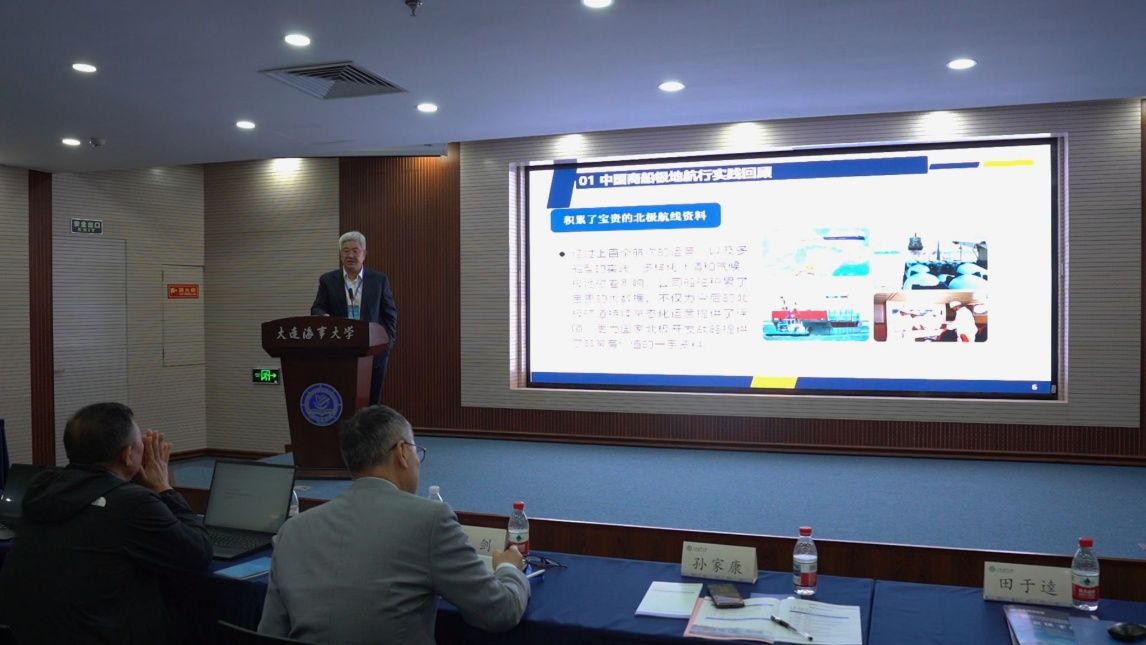
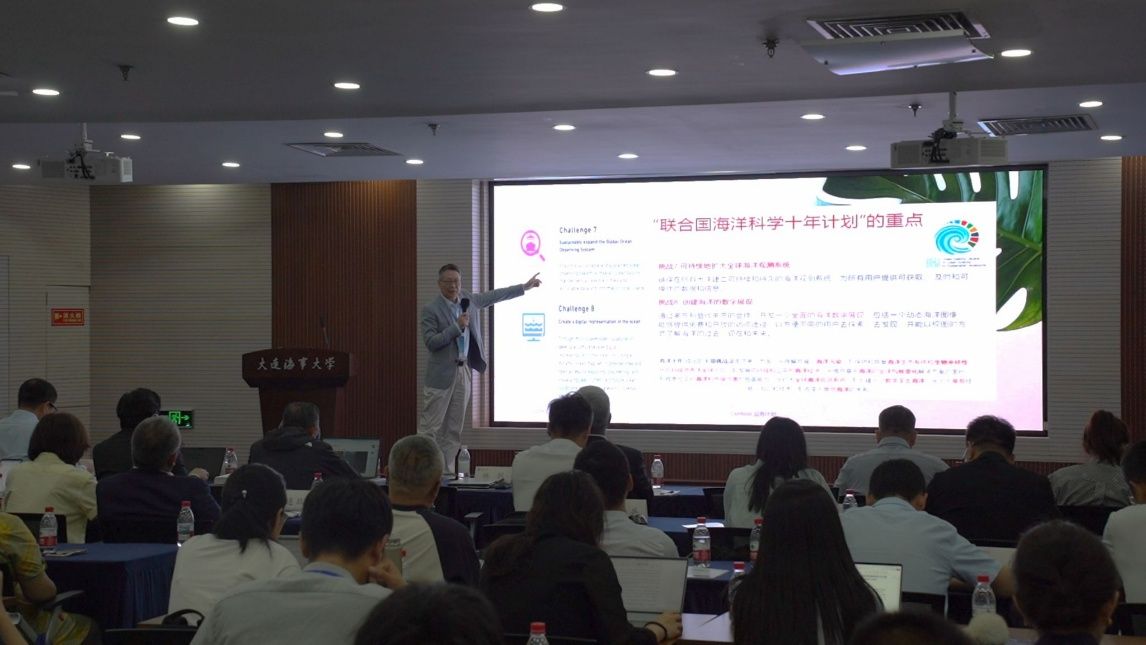

During the keynote session, Sun Jiakang, former Director and Deputy Party Secretary of COSCO SHIPPING Group, delivered a presentation themed “Safety of Polar Navigation and New Opportunities & Challenges for Arctic Shipping Development”. He interpreted the development landscape of Arctic shipping based on industrial practices. Yang Jian, former Vice President and Research Fellow of Shanghai Institutes for International Studies, presented a special report entitled “Spatio-Temporal Intelligence, Digital Twins and the Future of Arctic Governance”, exploring the application prospects of digital and intelligent technologies in Arctic governance. Dr. Gao Yufu from DMU gave a speech titled “Exploration and Breakthrough of Ice-Bound Territories: Current Status and Future Research Priorities of Polar Equipment Technology”, analyzing the state-of-the-art polar equipment technologies and identifying key research areas for future breakthroughs.

Two research achievements were released during the conference. Professor Li Zhenfu, Director of DMU’s Polar Maritime Research Center, launched his monograph Awakening of Hubs: Value Transformation of the Arctic Region and China’s Interests, elaborating on the evolution of Arctic value and China’s relevant development interests. Professor Zhang Xiufeng from the College of Navigation introduced her research team’s achievement — a polar navigation simulator, demonstrating the research progress of polar navigation simulation technology.


At two parallel forums on strategic security and shipping technology held in the afternoon, fifteen experts and scholars from domestic institutions engaged in Arctic strategic research, technological R&D and industrial practice had in-depth exchanges on a wide range of topics. Policy-related subjects included China-Russia Arctic shipping cooperation, trends of Arctic waterway development, security risks in Arctic governance, environmental supervision of polar shipping, and Arctic pollution control. Technical and practical issues covered ice basin tests for polar vessels, intelligent sea ice identification, practical operations of ice navigation, design and manufacturing of polar ships, application of remote sensing technology, ice load prediction, and the economic efficiency of waterway transportation.

The conference has been held for eight consecutive sessions, evolving into an influential academic exchange platform for Arctic research in China. Leveraging its disciplinary and platform strengths, DMU will further deepen research, talent cultivation and international cooperation concerning the Arctic, contributing to the development of a country with strong transportation network, a maritime power, and the sustainable progress of global Arctic undertakings.
 中文
中文


